Seller Financing

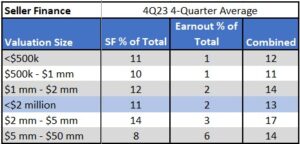
Many sellers and buyers want to know what “is market” for the amount of seller financing provided in a transaction. The table below shows the four-quarter average percentage of seller financing for 4Q23 based on the IBBA/M&A Source Market Pulse Report. Also shown is the average percentage amount of earnout provided. Note, these vary widely by company specifics. Feel free to reach out if you would like to learn more about how your company may be valued and how a transaction could be structured.

Business Brokerage/M&A Market Pulse 3Q20 – Part 3 of 3

By Brandon Mack

The International Business Brokers Association (IBBA) and M&A Source have recently published their third-quarter market research for 2020. The report is a statistical analysis of 352 respondents who answered this quarter’s 25 question survey. This is the final of a three-part series where I will examine the IBBA’s and M&A Source’s analysis of the market.

Sellers do not always get their asking price. For businesses sold under $500K, they only received on average 85% of their asking price. Businesses sold between $500K and $1M received 90% of their asking price. Businesses sold between $1M and $2M received 94% of their asking price. The $2M-$5M range received an average 96% of their asking price, and the $5M to $50M received 105% of their asking price.  Pricing the business correctly on the front end, with the ability to back-up the price with data, significantly improves this metric – as does focusing on revenue and profit growth while the company is for sale.

For businesses sold for under $500K, the most common industries in this range were personal services at 20%, business services at 13%, and consumer goods at 11%. 85% of deals in this range had no formal exit planning. In the $500K to $1M range, the largest industries in this range were personal services at 16%, healthcare at 14%, consumer goods at 12%, and construction at 12%. 77% of deals in this range did not have formal exit planning prior to engagement to sell. The most deals per industry in the $1M to $2M range are as follows: construction at 25%, manufacturing at 21%, consumer goods at 13%, and business services at 10%. There was more exit planning in this range, as 44% met with an advisor. In the $2M to $5M range, 19% of the businesses sold in this range were in construction, 16% were in business services, 14% were in manufacturing, 12% were in consumer goods, and 12% were in healthcare. 28% of sellers had met with an advisor to discuss exit planning. In the $5M to $50M range, 25% of the businesses sold in this range were in the construction industry, 15% were in business services, and 15% were in wholesale services. Exit planning was even more common in this range, as 53% met with an advisor.  One of the first steps to an exit plan is understanding the value of your business; starting two to three years before selling can give the Seller helpful insights to maximize their value.

In terms of seller financing, in the under $500K range, 15% (13% average over the last four quarters “LFQ”) of the price consisted of seller financing. In the $500K to $1M range, 7% (12% LFQ) was seller financing, in the $1M to $2M range, 11% (13% LFQ) was, in the $2M to $5M range 9% (13% LFQ) was, and in the $5M to $50M range 11% (9% LFQ) was seller financing.

Seller’s Discretionary Earnings (SDE) and Earnings before Interest, Tax, Depreciation, and Amortization (EBITDA) remained as the primary valuation metrics. Most of the transactions used SDE not including working capital multiples for businesses valued under $5M, and most of the transactions for businesses sold between $5M and $50M used EBITDA including working capital multiples. The inclusion of working capital in the purchase prices becomes more prevalent as the transaction size gets larger. For businesses valued under $500K, working capital was included only 21% of the time. For businesses $500K and $1M, 26% included working capital. For businesses $1M to $2M, 29% included working capital. For businesses $2M and $5M, 40% included working capital. Lastly, for businesses valued between $5M and $50M, 65% included working capital. When looking at comparable multiples, it is important to understand what basis the particular database uses as some explicitly exclude working capital in the calculation, while others include it. In other words, one must be careful not to apply a multiple that excludes working capital to an offer that includes it and vice versa.

Business Brokerage/M&A Market Pulse 3Q20 – Part 2 of 3

By Brandon Mack

The International Business Brokers Association (IBBA) and M&A Source have recently published their third-quarter market research for 2020. The report is a statistical analysis of 352 respondents who answered this quarter’s 25 question survey. This is the second of a three-part series.

This quarter, first-time individual buyers were the largest category of buyers for companies across the tiers, up through companies valued up to $2M. In the under $500K in valuation range, 47% of the buyers were first-time individuals, 30% were individuals who have owned a business, and 22% were sold to existing companies. In the $500K to $1M range, 41% were sold to first-time individuals, 39% were sold to individuals who have owned a business, and 20% were sold to existing businesses. In the $1M to $2M range, 40% were sold to first-time individuals, 37% were sold to individuals who have owned a business, and 17% were sold to existing businesses. In the $2M to $5M range, 28% were sold to first time owners, 30% to owners who have owned a business, and 30% were sold to existing companies. Lastly, in the $5M to $50M range, 15% were sold to first-time individuals, 25% were sold to individuals who have owned a business, 35% were sold to existing businesses, and 20% were sold to PE firms.

In the main street and lower middle market, the number one reason businesses are sold is due to the owner retiring. For businesses under $500K, retirement makes up 38% of the reasons for the seller to go to market. For businesses between $500K and $1M, retirement makes up 67%. From $1M to $2M, retirement makes up 69%, from $2M to $5M retirement makes up 65%, and from the $5M to $50M range, retirement makes up 60%. Many sellers this quarter are going to market because they found a new opportunity; this makes up 17% of sellers under $500K, 10% of sellers between $500K and $1M, 4% of sellers between $1M and $2M, 9% of sellers between $2M and $5M, and 15% of sellers between $5M and $50M.

Often, the buyers are located within 20 miles of the businesses being sold. For businesses valued under $500K, 72% of the sellers are within 20 miles. In the $500K to $1M range, 61% of the buyers are within 20 miles. In the $1M to $2M range, 52% of the buyers are within 20 miles. In the $2M to $5M range, 44% of the buyers are within 20 miles. Lastly, in the $5M to $50M range, 50% of buyers are located more than 100 miles away, likely representing strategic buyers or PE firms.

Buyers have their own reasons for purchasing a business. Smaller business owners buying themselves a job make up 45% of the under $500K range, 41% of the $500K to $1M range, 37% of the $1M to $2M range, and 26% of the $2M to $5M range. In the under $500K range, add-ons including both horizontal and vertical make up 40%, in the $500K to $1M range add-ons made up 32%, in the $1M to $2M range add-ons make up 35%, in the $2M to $5M range add-ons make up 27%, and in the $5M to $50M range add-ons make up 55%.

Business Brokerage/M&A Market Pulse 3Q20 – Part 1 of 3

By Brandon Mack

The International Business Brokers Association (IBBA) and M&A Source have recently published their third-quarter market research for 2020. The report is a statistical analysis of 352 respondents who answered this quarter’s 25 question survey. This is the first of a three-part series.

There was an increase in deals that happened in Q3. Advisors completed 301 transactions, an increase of 71% from last quarter and 43% year over year. The CARES Act incentives have been driving some of the acquisitions in Q3, as the SBA provided a six-month subsidy of principal and interest for acquisitions that were completed before Sept 27th.

The pandemic has had a unique impact on business brokers and their clients:  35% of businesses are operating at partial capacity, 34% have returned to operate at full capacity, 6% are temporarily closed, 16% are unaffected, and 9% have benefited. 7 6% of respondents answered that the pandemic will have a negative effect on business values. 14% of respondents believe that it will take until 2021 Q1 for M&A activity to return to pre-March levels (down 10% from last quarter); 29% believe it will take until 2021 Q2 and 17% believe it will take until 2021 Q3.  However, here in the Carolinas, we are seeing a resurgence in buyer interest for solid companies.

For businesses sold for under $500K, the median number of months from listing to close was eight months.  For businesses sold between $500K and $1M, the median was ten months. From $1M to $2M the median from listing to close was ten months, and from $2M to $5M the median was nine months. In the $5M to $50M range, it was ten months.

Seller’s Discretionary Earnings (SDE) and Earnings before Interest, Tax, Depreciation and Amortization (EBITDA) median multiples are not far off from last year’s multiples. In the under $500K range, the SDE median multiple paid increased to 2x. In the $500K to $1M range, the SDE multiple decreased to 2.5x. In the $1M to $2M range, the SDE multiple decreased to 3.0x. The EBITDA multiple paid in the $2M to $5M range stayed the same at 4.0x. In the $5M to $50M range, the EBITDA multiple increased back to 5.9x from 5.5x.

Want to Sell Your Company in 2020 – Do These 4 Things Now

By Ron Buck, Regional Director, Murphy Business & Financial – Carolinas

If you are considering selling your company in 2020, back by popular demand are four (and a half) things you should be doing (or not doing as the case may be) between now and year end, as well as over the next few months.

First, here is a little exit planning background before we tackle the to do list. According to a recent study by Business Enterprise Institute (BEI): “79% of business owners plan to exit their businesses in the next 10 years. However, the survey shows that a majority of all business owners have not identified all of the steps necessary to exit their businesses successfully, and fewer still have created written Exit Plans. Despite understanding the importance of planning in a successful exit, most owners have not yet identified all of the necessary steps to exit their businesses successfully. Fewer still have (a) hired and/or trained employees to take over business responsibilities and (b) obtained a business valuation, both of which are critically important to a successful business exit, regardless of the chosen Exit Path.” So, if you are a few years away from implementing your exit strategy, now is the time to start planning, obtaining a valuation, and getting the company in shape to sell and maximize the sales price.

Now for the tactical steps you need to do in the next few months if you are planning on selling in 2020, or even 2021.

First, plan now with your accountant to be first on their list of tax returns to be completed in 2020. Buyers and bankers prefer to see tax returns for the most recent year and will not give full weight to internally generated P&Ls. So, plan early, talk with your accountant, and get yours finished early – don’t get caught in the March/April crush with everyone else, and by all means, DO NOT plan on filing an extension. And a bonus corollary:  while the 2018 The Tax Cuts and Jobs Act expanded the number and types of companies eligible to use the cash method of accounting for filing taxes, weigh that choice carefully. Here’s why: tax returns are the source of choice (as opposed to internal P&Ls) and the accrual method is the method of choice for buyers, bankers, and valuations, as this method provides a more accurate picture of the financials and profitability of a company. So, if you are on the cash method already for your taxes, or are going to switch, ask your accountant for a cash to accrual reconciliation or conversion to go along with your tax returns. This step will provide the roadmap, via the balance sheet, of how the two different methods relate to each other.

Second, don’t Give Up $2 to Save 30 Cents by expensing unverifiable, undocumented personal expenses that we won’t be able to add back to your cash flow calculation. As the linked article explains, this is a terrible trade-off as the title indicates.

Third, now is NOT the time to aggressively manage your year-end taxes – particularly if you are simply accelerating expenses and deferring revenue recognition. This is more detrimental to your overall financial gain than Giving Up $2 to Save 30 CentsIn this situation, you are literally only saving the net present value of the interest income from a year’s delay in paying the inevitable tax, but could be decreasing your company’s valuation and your gross proceeds.

At this point of your exit strategy, your financials should reflect the fundamental earnings capacity of the business so that potential buyers can clearly see the cash flow and profitability opportunity in front of them. With the exception of contributing to retirement accounts, paying for health, life, and disability insurance (all of which are easily documented and added back) and perhaps a few other items, have an in-depth discussion with your accountant and M&A Advisor and leave the tax and accounting gymnastics out of the equation.

Fourth, but not least important, continue to focus on revenue growth and bottom-line profitability. Positive trends show buyers that the company has a viable value proposition, is competitive in its market place, and can generate the cash flow needed for the buyer to cover their debt service and earn a return on their investment.

With a little planning, forethought, and discipline, your actions over the next few months can significantly improve the prospects of selling your company, successfully executing your exit strategy, and maximizing your net worth.